
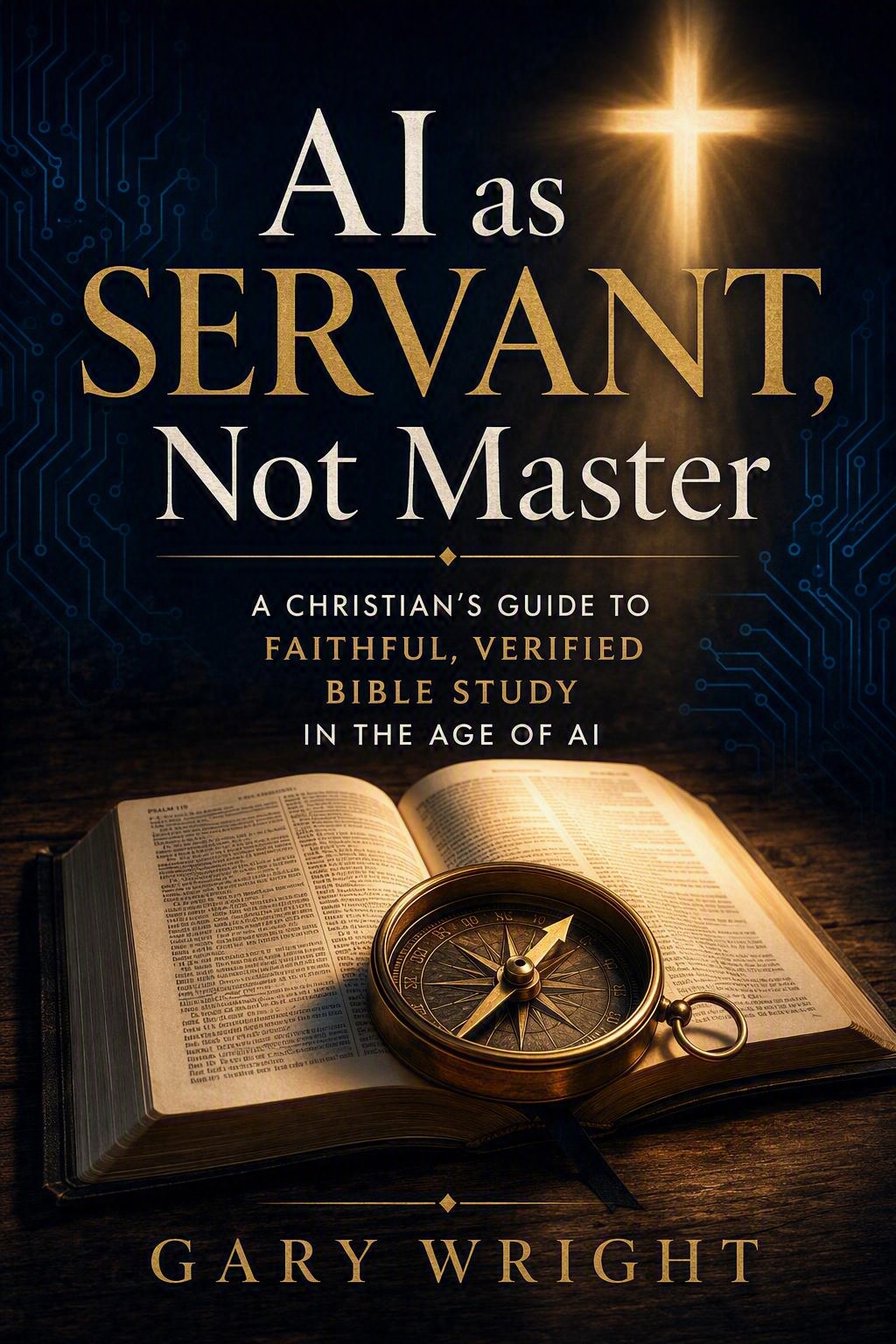
AI as Servant, Not Master
Ready for Copy-Editing
Expected 2027
Book Overview
AI as Servant, Not Master is a practical guide to using artificial intelligence in serious Bible study or research without surrendering your judgment to it.
The argument is simple and uncomfortable: these tools belong in study only when every claim they produce can be traced to a source you can open yourself. A language model that invents a plausible citation is not a research assistant. It is a confident stranger, and confidence is precisely what it is built to produce, whether or not it knows anything.
Gary Wright writes as someone who works in privacy and data governance and is completing a master’s of legal studies at Seton Hall Law with a concentration in privacy and cybersecurity law. I offer advanced research skills for veterans’ recovery groups and teach in a men’s Bible study. The book shows how to put these tools to work tracing a word from Hebrew through Greek into English, comparing critical texts against the Septuagint, and checking what a model tells you against lexicons and published scholarship you can verify. It also shows where the tools fail and why those failures are hardest to spot, especially where they matter most.
Why I Wrote This Book
I wrote this book because I watched people I respect take a machine’s word for what Scripture says yet hear some that don’t trust AI and see it as harmful.
Not carelessly. They asked reasonable questions and received fluent, confident, well-organized answers, some of which were wrong in ways that would take a trained reader an hour to catch. The tool never signals the difference. It sounds the same when it is right and when it is inventing.
I spend my working life on data and AI governance, where the discipline asks how to verify a claim and who is accountable when it cannot be verified. Bringing that habit to Bible study did not make me distrust these tools. It made me insist that they show their work. This book is the method I arrived at, written for pastors, teachers, study leaders, and anyone who wants help without the hazard, and it shows how to build trust in what AI can produce when given specific instructions. Our human interaction setting guardrails on how AI responds is critical.
Provide your email below and I will send you a sample chapter.
Who Should Read This Book?
Pastors and Teachers
If you prepare sermons or lessons on a deadline, these tools are already in your study whether you invited them or not. This book is about using them in a way you could defend from the pulpit or the classroom.
Small Group and Bible Study Leaders
If someone in your group arrives with an answer they got from a chatbot, you need a way to check it that does not require a seminary degree. That method is most of this book.
Seminary and Bible College Students
You are being trained to work from primary sources. This book shows how these tools can speed that work up without quietly doing it for you.
Christians Already Using AI, and Uneasy About it
If you have caught a tool inventing a verse, a citation, or a commentator, you already know the problem. Here is the discipline that catches it every time.
Christians or Others Avoiding AI Entirely
Avoidance is a defensible position and it is getting harder to hold. This book makes the case for a third option between adoption and refusal.
Anyone Who Has Been Given a Confident Wrong Answer
The danger is not that these tools will fail. They fail in the same reassuring voice they use when they succeed. It is a skill to learn to hear the difference and it can be taught.
Get an Early Look
Read a sample chapter of AI as Servant, Not Master, now before it releases. Get the Sample Chapter by entering your email below, and I will send you a chapter, plus occasional notes on faith, technology, and studying Scripture with your eyes open.
Begin the Journey
Learn how to put these tools to work in your study, and how to know when they are making it up.